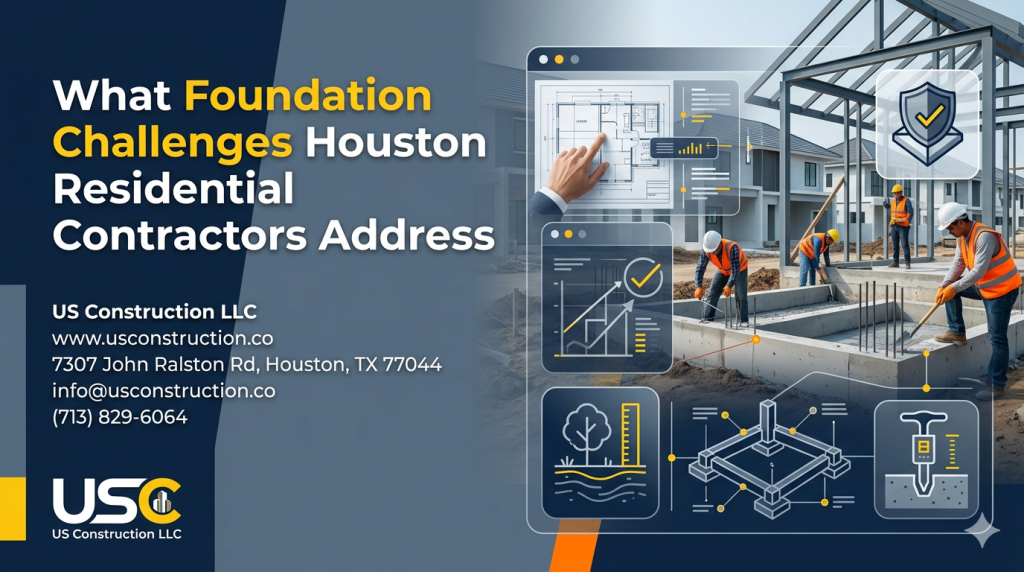
The foundation development process and type depend on soil conditions, groundwater table level, and high-temperature fluctuations with heavy rainfall. What foundation challenges Houston residential contractors address to mitigate premature damage and structural strength? Suitable foundation pouring prevents differential settlement, slab cracking, and pier-and-beam movement.
US Construction LLC conducts extensive site excavation and soil stabilization to improve ground load-bearing capacity and consistent soil compaction. Effective foundation design selection, geotechnical assessments, and pre-treatments are essential for home construction durability, safety, and property value.
Common Types of Residential Foundations
The soil type, temperature, architectural load requirements, and financial constraints all affect residential foundations. The choice of foundation is effectively managed by the Houston residential contractor, given the expansive clay soils and high moisture levels. The most popular types of residential foundations are listed below:
| Slab-on-Grade Foundation A single layer of concrete is poured directly onto the prepared soil. |
| Important attributes:A slab of reinforced concrete, usually post-tensioned in Texas Very little excavation No basement or crawl space Benefits Economical Minimal upkeep A quicker schedule for building Ideal For: Warm regions with shallow frost. |
| Post-Tension Slab Foundation An alternative to slab-on-grade that strengthens the structure by embedding tensioned steel cables in the concrete. |
| Important attributes:Strong opposition to soil movement Increased capability for load distribution Benefits Lessens expansive soil cracking Ideal for: Works effectively in areas with high clay content. |
| Pier and Beam Foundation The structure is raised on concrete piers, and wooden beams support the floor system. |
| Important attributes:The area beneath the houseAn elevated building Benefits Simpler access to electrical and plumbing Does well in areas that are prone to flooding Better able to adjust to slight soil movement Common in: Older houses and places where drainage is an issue. |
| Crawl Space Foundation Similar to pier and beam, but with a shallow subfloor created by longitudinal slabs of concrete and walls of cement. |
| Important attributes:• An elevated building• A crawl space that is enclosed or ventilated Benefits• Prevents minor flooding• More convenient access to utilities |
| Basement Foundation A full-depth foundation that adds more below-grade storage space. |
| Important attributes: Slab floors and concrete walls Subterranean construction Benefits Additional square feet that can be used Houston has strong structural stability because of its high-water table and favorable soil conditions. |
| Raised Slab Foundation A hybrid technique that combines a small elevation above grade with a slab structure. |
| Important attributes:• Enhanced resistance to dampness• Improved drainage capacity |
Foundation Challenges in Houston Residential Construction
Houston residential construction companies use a specific foundation design depending on soil composition, climate fluctuations, and drainage patterns. These assessments are important for sustaining structural and geotechnical pressures. Contractors dealing with several recurrent and challenging technical foundation issues:
Expansive Clay Soil (High Plasticity Index)
The prevalent clay soils shrink during dry times and expand when they absorb water. Differential settling beneath slabs and pier-and-beam structures is caused by this volumetric movement, which results in:
- Cracking slabs
- Fractures in the interior walls
- Misalignment of windows and doors
- Distortion of the structural frame
A weak base is more stressed by repeated wet-dry cycles.
Differential Settlement
One part of a framework settles more than another due to irregular soil compaction or variations in moisture below the foundation. This leads to:
- Floors that slope
- Separation at the joints of the brick facade
- Cracks in the ceiling
- Gaps in the foundation’s perimeter
One of the most prevalent structural hazards in Houston homes is settlement variations.
High Water Table and Poor Drainage
Drainage issues are exacerbated by Houston’s flat terrain and excessive rainfall. Poor stormwater structures, blocked gutters, or poor grading can result in:
- Overflow of the soil
- Erosion under footings
- Hydrostatic force applied to slabs
- Early degradation of the foundation
Inadequate drainage weakens load-carrying capacity and accelerates soil movement.
Tree Root Intrusion
Large trees placed close to dwellings draw rainwater from clay soils unevenly. This localized dryness contributes to structural instability and cracking by causing soil shrinkage beneath particular foundation sections.
Improper Soil Compaction
Long-term instability is unavoidable if fill dirt is not sufficiently compacted before slab placement. Inadequate compaction creates cavities beneath the groundwork, which, over time, raises the possibility of structural displacement.
Flooding and Soil Erosion
The stabilizing soil surrounding slab edges and piers may be washed away due to Houston’s susceptibility to strong storms and rapid flooding. Subgrade instability is jeopardized, and the framework is weakened by repetitive flood exposure.
Aging Slab-On-Grade Construction
Slab-on-grade footings, which lack contemporary humidity controls, post-tensioning, and sophisticated engineering, were used in the construction of many older Houston homes. These systems are more prone to movement and breaking over time.
Strategies to Manage Foundation Development Challenges
To combat expanded clay soils, elevated groundwater levels, and hydraulic permeability, seasoned residential contractors in Houston rely on technical mitigation techniques. The following strategies are commonly used in effective underpinning risk management:
Geotechnical Investigation and Testing
To ascertain soil bearing strength, elasticity index, and humidity behavior before construction. Contractors arrange soil sampling and topographical studies. Under-engineered slab technologies are avoided, and this data informs foundation planning.
Engineered Foundation Design
Instead of using standard slab requirements, contractors use:
- Slab-on-grade systems with anchors
- Foundations made of reinforced cement
- Pier and frame systems with structural design
When necessary, deep foundation piers are made of steel or concrete. These solutions reduce the likelihood of differential settlement and more evenly distribute structural stresses.
Moisture Control Management
Managing water is essential because soil movement is driven by moisture. Installers are contractors.
- Appropriate grading of the site
- Surface sewer lines and French drains
- Longer outflow for gutters
- Catch basins and ditches
- Barriers to moisture above slabs
By doing this, water pressure accumulation and excessive saturation are avoided.
Soil Stabilization Techniques
Mitigation strategies for regions with extremely expansive soils could include:
- Subgrade stabilization with lime treatment
- Chemical stabilization of soil
- Replacement of compaction structural fill
- Moisture treatment before slab installation
These techniques lessen clay soil shrink-swell behavior.
Proper Compaction Protocols
To remove voids and prevent long-term settlement, contractors adhere to stringent compaction standards during site preparation by using mechanical compactors and regulated lifts.
Pier Installation for Existing Foundation
When a house moves, contractors install piers made of pressed concrete, helical piers, and push piers made of steel. These shifts load onto the structure onto more stable, deeper earth layers.
Tree and Landscaping Management
Contractors advise the following to avoid uneven soil drying: keep watering consistently and put in root barriers. Maintaining a safe space between big trees and foundations.
Houston Residential Contractor Near Me
To avoid costly foundation problems in Houston, early assessment, engineered solutions, and precise implementation are required. Houston housing developers offer guarantees of long-term stability and safeguards for your real estate investment against drainage issues, migration, and soil movement.
US Construction LLC provides structurally solid, code-compliant solutions for home development. Make an appointment for your expert evaluation by calling (713) 829-6064 or visiting www.usconstruction.co.
Leave a Reply